

STRIDE at the ‘Rhetorical Citizenship and Democratic Education in the Baltic Sea Region Conference’
Södertörn University in Stockholm hosted the conference ‘Rhetorical Citizenship and Democratic Education in the Baltic Sea Region’ from 6–8 May 2026, bringing together researchers, educators and practitioners to examine how schools can foster rhetorical and deliberative competencies that strengthen democratic participation and civic resilience.
The conference focused on how education systems can properly prepare young people to engage critically, constructively, and ethically in democratic societies shaped by rapid political, social, and digital transformations.
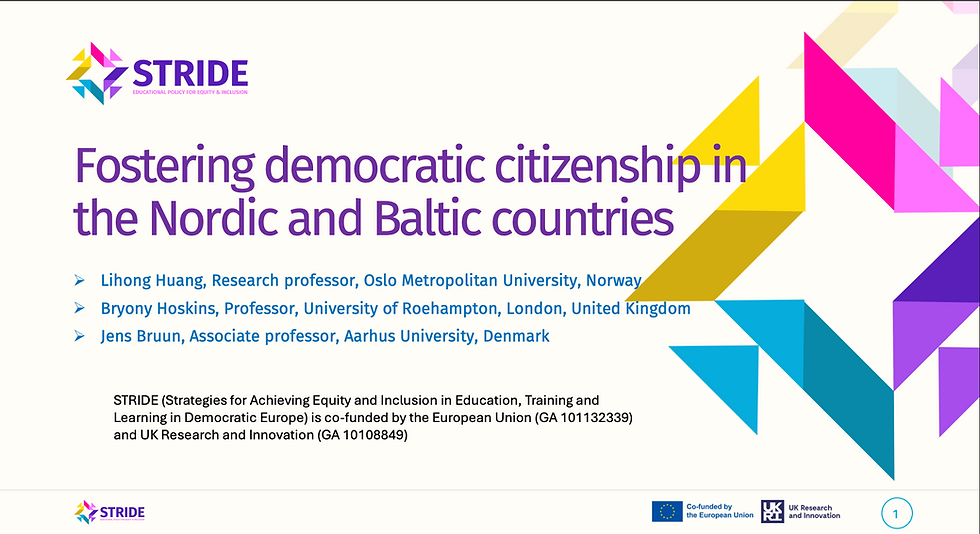
STRIDE was mentioned by Lihong Huang, Research professor, Oslo Metropolitan University, Bryony Hoskins, Professor, University of Roehampton and Jens Bruun, Associate professor, Aarhus University; during Sessions 1 and 2 that took place on Wednesday 6th May from 15:00–17:00.
Their presentation titled ”Fostering democratic citizenship in the Nordic and Baltic countries”, referenced STRIDE and its work on equity, inclusion, and democratic participation in education.
Their presentation introduced the editorial framework of a recent special issue published at JSSE (Journal of Social Science Education) dedicated to democratic citizenship education in Europe.
Drawing on data from the International Civic and Citizenship Education Study (ICCS) from 2009, 2016, and 2022, the research provides an overview of citizenship education from students, teachers and school leaders’ perspectives across six countries: Denmark, Estonia, Latvia, Lithuania, Norway, and Sweden.
The analysis explored several key themes shaping democratic citizenship education today. These included developments in civic knowledge and expected political participation among students, school autonomy in curriculum and teaching decisions, and the teaching and assessment practices commonly used in citizenship education.
The overview is structured by results from analyses of three types of participants:
1) Student data, we present trends of civic knowledge achievement and expected political participation
2) School principal data, we present trends of the most important aims of citizenship education and school autonomy in citizenship education on issues such as curriculum planning, choice of textbooks and teaching materials
3) Teacher data, we present trends of learning assessment methods and teaching methods often used by citizenship education teachers.
Democratic citizenship education should not be understood only as the transfer of civic knowledge; it also involves creating learning environments where young people are encouraged to engage critically with information, listen to diverse perspectives, and recognise their own role in shaping democratic futures.
The discussions at Södertörn University reinforced the importance of collaboration between researchers, educators, policymakers, and civil society actors in strengthening democratic education across Europe. As democratic challenges continue to evolve, so too must the educational approaches designed to prepare young people for active, reflective, and responsible participation in society.
Read the special issue here: https://www.jsse.org/index.php/jsse/issue/view/512

Comments