

The EU Teachers and Trainers Agenda: Essential but not enough for the education and training ecosystem
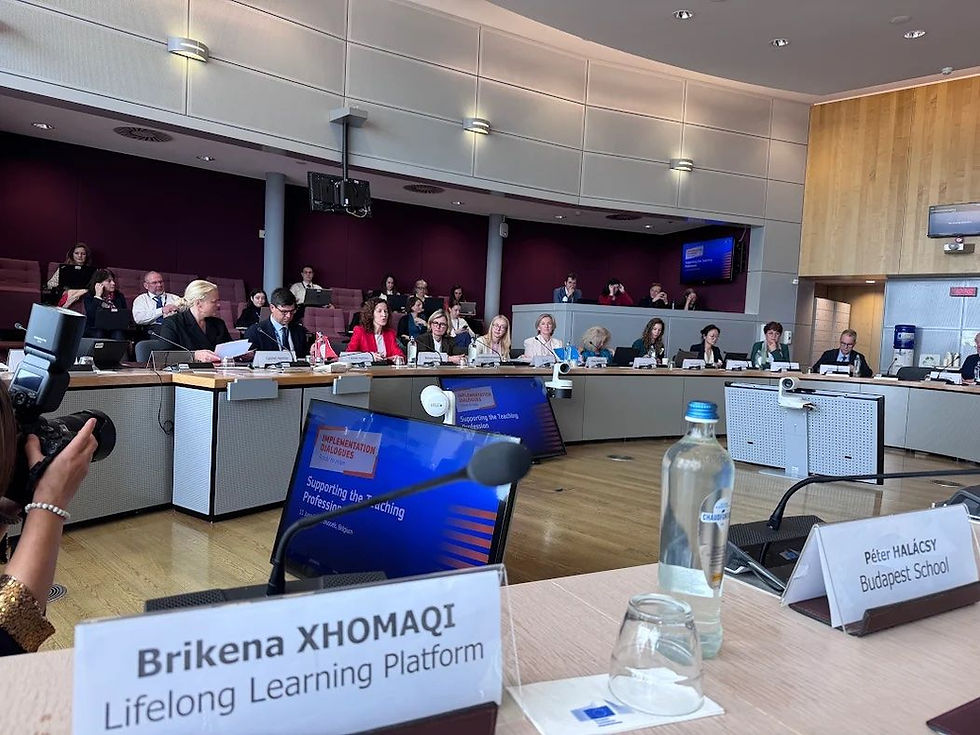
On 11 June, the Lifelong Learning Platform was delighted to be invited by the European Commission Executive Vice-President (EVP) Roxana Mînzatu to the Implementation Dialogue on the upcoming EU Teachers and Trainers Agenda. The Dialogues are highly appreciated and showcase her willingness to engage with all relevant stakeholders prior to the preparation of crucial files. LLLPlatform welcomes the Commission’s initiative to launch an Agenda for the practitioners in the education and training sector after years-long challenges reported in the Education and Training Monitors.
LLLPlatform participated in the previous series of consultative workshops organised by the European Commission’s Directorate-General for Education, Youth, Sport and Culture (DG EAC), and we strongly encourage that the outcomes of the workshops be combined with the perspectives from the Implementation Dialogue to ensure that the direction of the upcoming Agenda matches the diverse perspectives of the stakeholders involved. The recommendations of the LLLPlatform have been shared after the Dialogue.
LLLPlatform in its contribution at the Implementation Dialogue highlighted in particular the importance of the urgency of Europe to act in broader terms, targeting its intervention towards all educational staff that support the teaching profession. Therefore, we stressed that a narrow perspective on teachers and trainers alone perpetuates the misconception that they are fully responsible, on top of teaching, of administrative procedures, social assistance to learners, increasing inclusive practices in their institutions, digitalising teaching methods, amongst others. As highlighted in our 2024 Position Paper on the educator profession, it is time to look at education and training as a professional ecosystem with multiple roles and stakeholders. The Agenda must include support personnel, and reflect on which other stakeholders can help the education and training staff. If it takes a village to raise a child, then it cannot take only teachers to ensure a culture of lifelong learning across our societies. Moreover, low numbers of adults in learning are linked with an insufficiently developed and supported adult education ecosystem. Trainers, as a term, should have extended to those working with adults as well.
The Agenda must focus on providing adapted support to the needs of each educator. As many other stakeholders, LLLPlatform also called for EU programmes such as Erasmus+ and European Social Fund+ to be strengthened and provide concrete solutions to the professionals in all education systems by strengthening their cooperation across Europe, resources, guidance, peer learning, innovation through exchange of practices and co-creation. We all recognised that so far Erasmus+ is the most effective European initiative in support of the teaching professionals. In addition, educators are overwhelmed with the amount of frameworks developed and with the associated guidelines for their implementation. The power of the EU stays in the capacity to develop resources such as the Guidelines on the ethical use of AI and data in teaching and learning, but ensuring it develops only on a few and targeted such Guidelines, while improving their user-friendliness.
In our Recommendations, we call for educators to be represented in the relevant decision-making fora of the European Commission, such as its European Education Area Working Groups.
We also call for meaningfully leveraging the EU’s economic governance to ensure that educators are supported to deliver the lifelong learning supported by the Union of Skills. The prominence of educators must increase in the European Semester, specifically on two accounts. There is a need for clearer Country Specific Recommendations on how to support the educator profession, providing good practice examples from the existing initiatives mentioned above. Moreover, it is crucial to ensure that the EU is measuring how the situation is changing for all professionals in the sector. This requires a reference in the Country Reports and the Recommendations to all staff members in education and training, monitoring how the professional ecosystem is changing, but also more granular targets on initial teacher education and on continuous professional development, understanding which educators are more likely to pursue training and why.
We look forward to working together with the European Commission to make the EU Teachers and Trainers Agenda a reality for all.

Comments